Online Returns & Product Discovery
Industry
Ecommerce
Client
Officeworks
Role
Product Designer
Date
2019
This project focused on improving the online returns experience while also exploring opportunities to simplify product discovery. Through a combination of user research, journey mapping, collaborative workshops and prototyping, I identified friction points in the purchasing and returns journey and developed a clearer, more intuitive experience for customers.
SCOPE
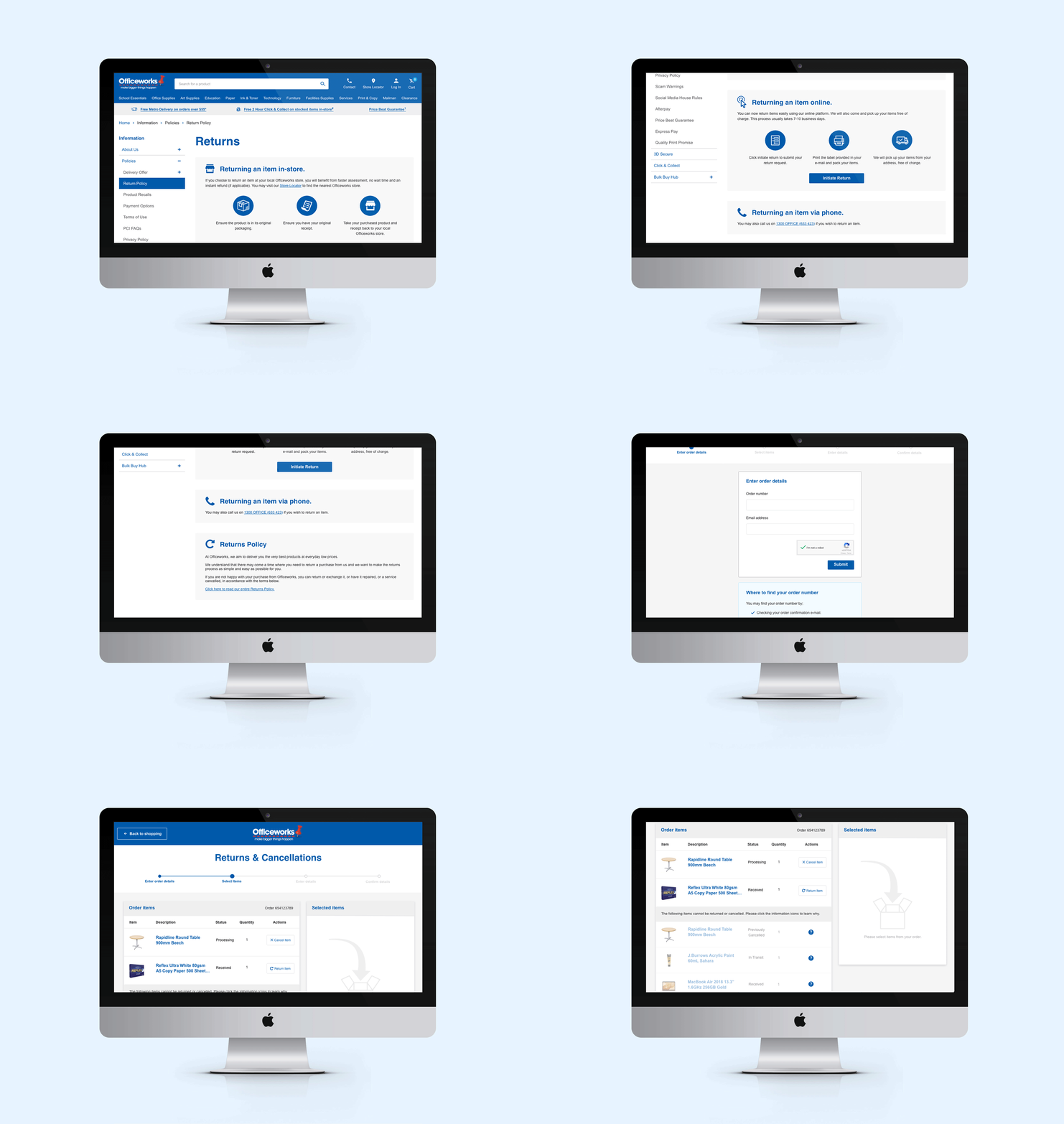
This project explored improvements to the online returns experience, with the goal of reducing friction between online purchases and the return process. Through research, journey mapping, workshops and usability testing, the work aimed to better understand customer behaviour and identify opportunities to simplify the purchasing and returns journey.
In addition to the returns improvements, one of the enhancements I contributed was the introduction of Product Families, a concept designed to group product variations and simplify how customers discover and compare related products.
ROLE
As the sole UX/UI designers in the Ecommerce Transformation team, my responsibilities included:
• User research and survey analysis
• Competitor research
• Persona creation
• Customer journey mapping
• Wireframing and prototyping
• Workshop facilitation and ideation
• Usability testing and iteration
• Presenting concepts to stakeholders
PROBLEM
Customers purchasing products online often encountered friction when navigating the returns process or trying to understand differences between similar product variations.
Initial investigation highlighted several common issues:
• Unclear pathways for initiating online returns
• Confusion between online and in-store return processes
• Difficulty navigating between related product variations
• Fragmented touchpoints across the purchase and post-purchase journey
These challenges created unnecessary complexity within what should be a straightforward purchasing and returns experience.
UX METHODOLOGY
USER RESEARCH
The project began with user research to better understand how customers interacted with the Officeworks online purchasing and returns experience. Insights were gathered through user surveys and internal behavioural data, helping identify common patterns across the customer journey. This research focused on how users:
• Discovered products
• Compared product variations
• Navigated the purchasing flow
• Attempted to initiate returns
The findings revealed that while the purchasing experience was generally clear, the returns process and product navigation often created confusion, particularly when customers needed to move between online and in-store touchpoints. These insights informed the next phase of the project.
To understand how similar platforms approached product discovery and post-purchase experiences, competitor research was conducted across a number of retail and e-commerce platforms.
This review focused on how other platforms structured:
• Product variation navigation
• Returns processes
• Product categorisation
• Product comparison experiences
The insights helped identify patterns that could improve how Officeworks customers browse related products and manage returns.
PERSONAS
Based on the research insights, personas were developed to represent key customer groups interacting with the Officeworks platform.
These personas helped highlight differences in how customers approached purchasing, comparing products and returning items.
Personas provided a useful reference point throughout the design process, ensuring that proposed improvements addressed real customer behaviours and expectations.
JOURNEY MAPS
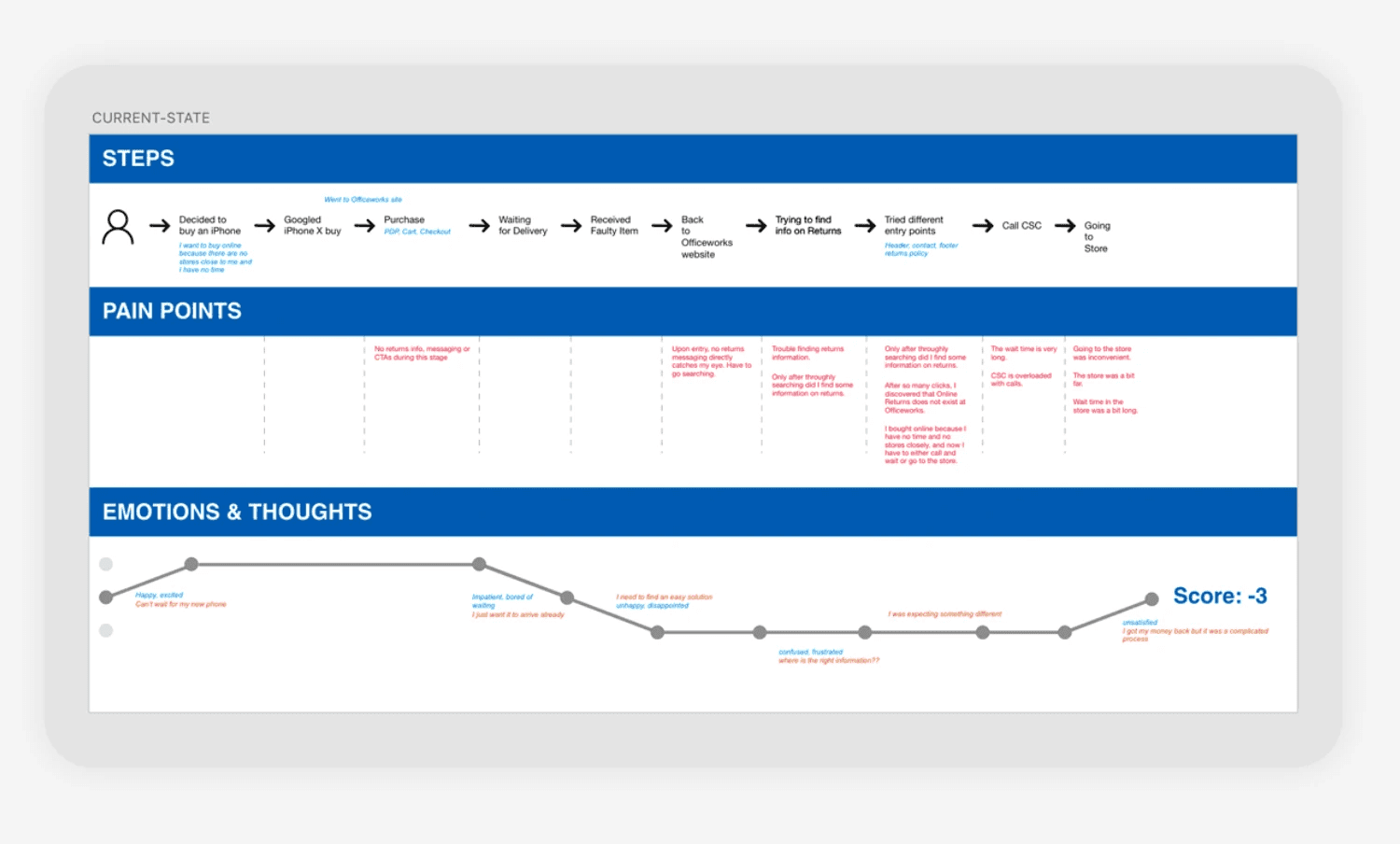
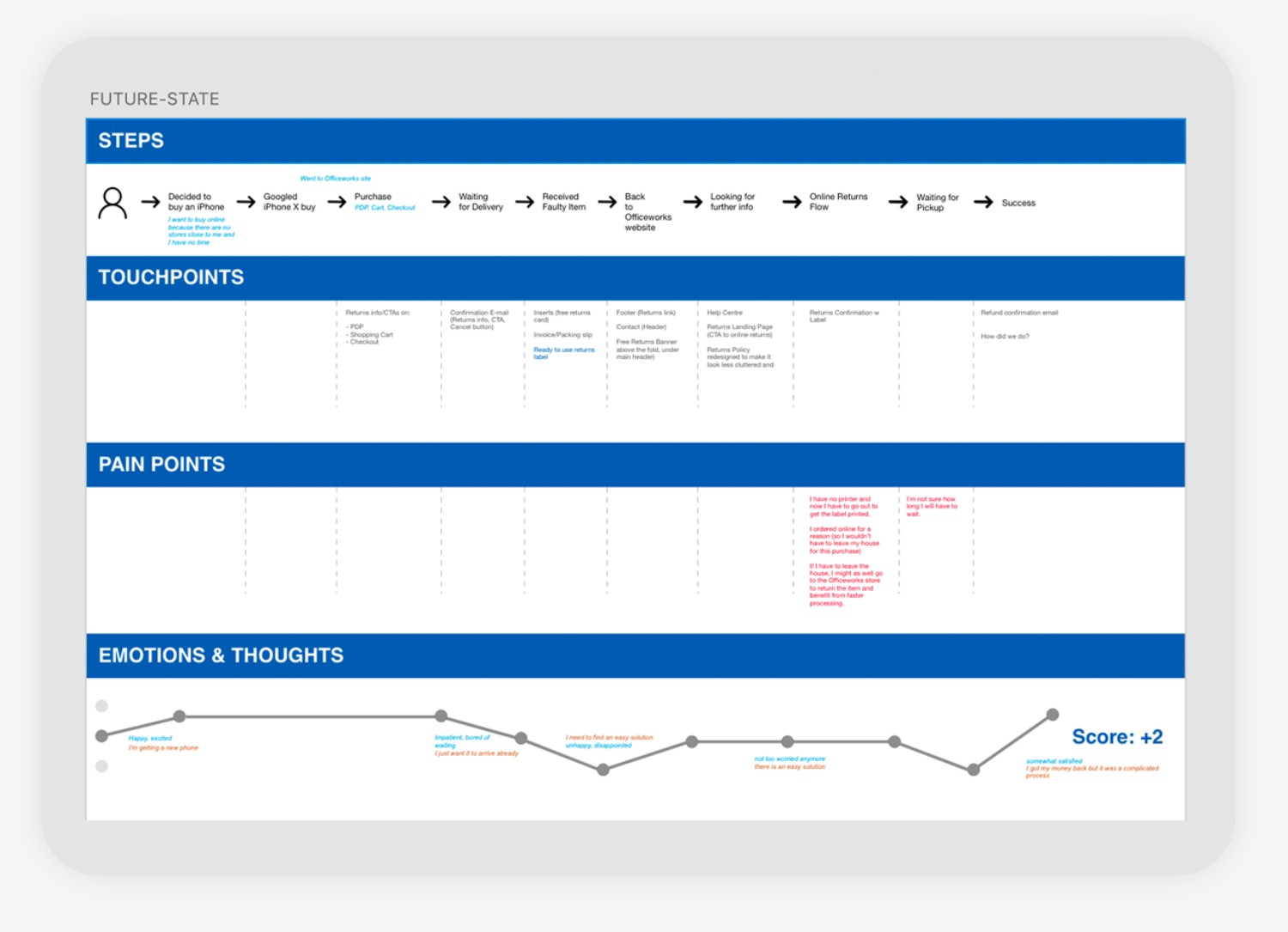
To better understand the full purchasing and returns experience, both current-state and future-state customer journey maps were created.
The current-state journey map visualised the existing experience from initial product discovery through to delivery and returns, highlighting friction points across the journey. The future-state journey map explored opportunities to simplify the process and create a clearer pathway for online returns.
Mapping both states helped identify where the experience could be streamlined and where design interventions would have the greatest impact.
EARLY CONCEPTS
To better understand the full purchasing and returns experience, both current-state and future-state customer journey maps were created.
The current-state journey map visualised the existing experience from initial product discovery through to delivery and returns, highlighting friction points across the journey. The future-state journey map explored opportunities to simplify the process and create a clearer pathway for online returns.
Mapping both states helped identify where the experience could be streamlined and where design interventions would have the greatest impact.
WIREFRAMES
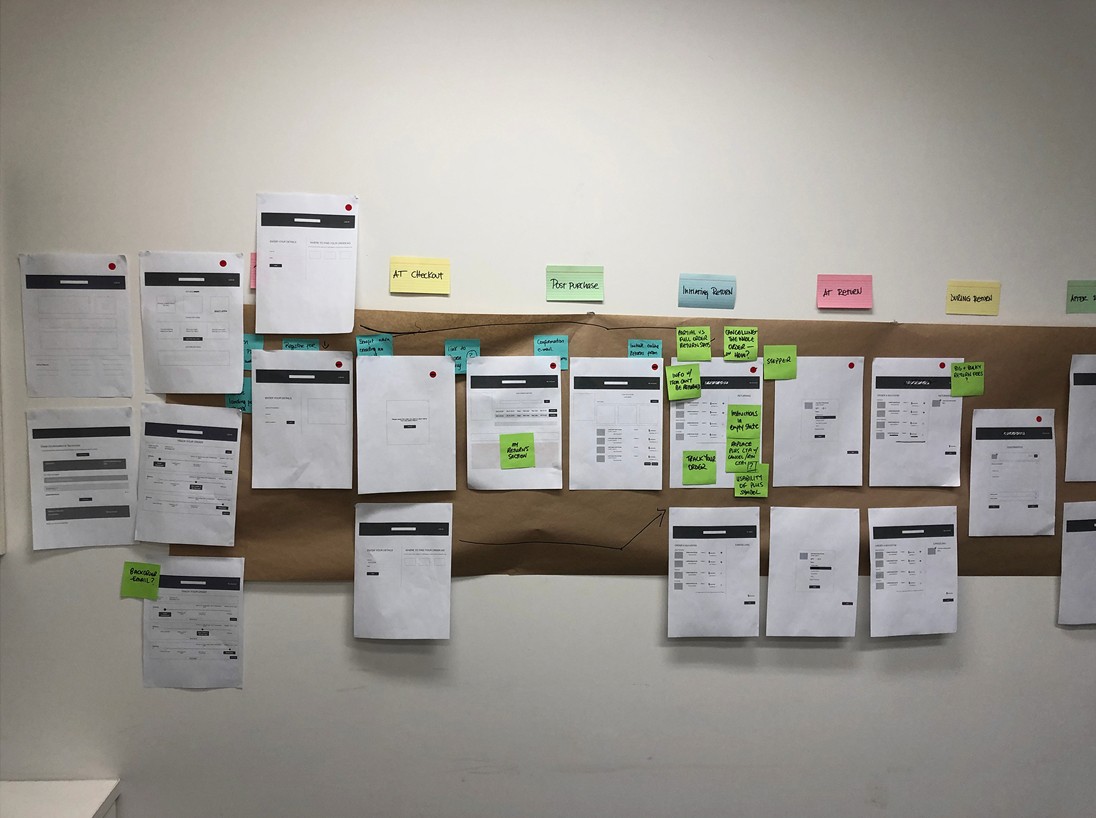
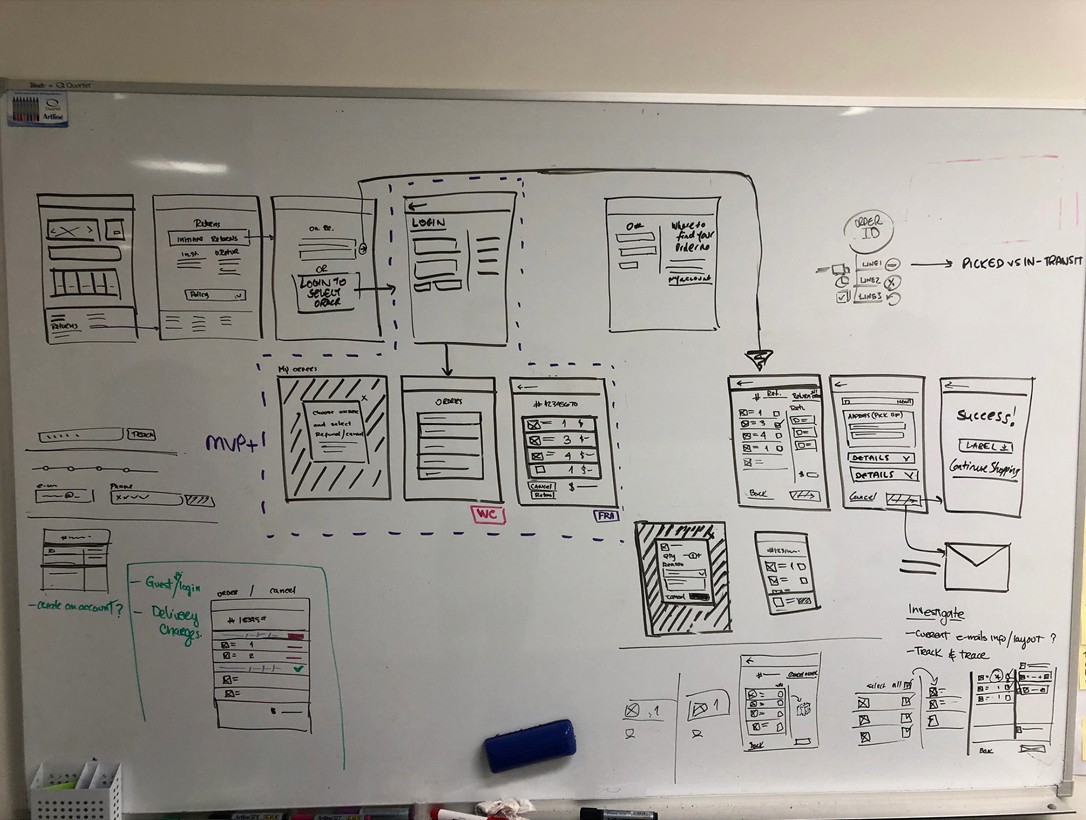
Following the journey mapping phase, early wireframes were developed to explore improvements to the purchasing and returns experience.
Wireframes allowed the team to quickly test potential flows and identify clearer pathways for initiating returns. This stage also explored how the platform could better support navigation between related products.
Low-fidelity designs helped validate the overall structure of the experience before moving into more detailed concepts.
PROTOTYPE

The proposed improvements were explored through a series of prototypes, beginning with low-fidelity wireframe prototypes to validate the structure of the returns flow and key interaction patterns.
These concepts were then developed into a higher-fidelity prototype in Figma, allowing the team to simulate the revised purchasing and returns experience end-to-end.
The prototype demonstrated how customers could move through product discovery, purchasing and the online returns process in a more streamlined way, while also helping communicate the proposed improvements to stakeholders and supporting usability testing.
USABILITY TESTING
Usability testing sessions were conducted with participants interacting with the prototype to evaluate the clarity of the proposed experience. Testing focused on:
• Ability for users to locate and initiate the online returns process
• Clarity of the steps required to return a purchased item
• Understanding of return eligibility, conditions and timeframes
• Ease of completing the return request without needing customer support
• Confidence that the return request had been successfully submitted
Feedback from participants helped identify areas where the experience could be further refined and validated many of the design decisions made during earlier stages of the project.
PRODUCT FAMILIES

Alongside the returns experience work, a related concept called Product Families was explored.
Product Families introduced a structured way to group related product variations — such as different storage capacities, colours or configurations — under a single parent product.
This approach allowed customers to easily compare variations without navigating between multiple separate product listings, simplifying product discovery and improving product comparison.
This solution provided a scalable way to manage complex product ranges and has since become part of the Officeworks product experience.
OUTCOME
The project established a clearer framework for improving the Officeworks purchasing and returns experience while simplifying how customers navigate complex product ranges.
Usability testing of the proposed designs demonstrated significant improvements in clarity and task success across the returns journey. Participants were able to locate and initiate the returns process 35% faster, with substantially fewer points of confusion compared to the existing experience.
Successful completion of the return task during testing increased from 58% to 89%, indicating a far clearer and more intuitive process for customers attempting to return items purchased online.
In addition, the Product Families concept improved product discovery and comparison by grouping related product variations under a single listing. During testing, participants were able to identify and compare relevant product variations 40% faster, reducing the need to navigate across multiple product pages.